Protect the cargo. Protect the sea.
Some dangerous goods don’t burst into flames.
Some don’t explode.
Some don’t even look scary.
They just sit quietly in a drum, carton, bottle, bag, or container.
Very calm.
Very ordinary.
Very “nothing to see here.”
But if they leak into the sea, river, drain, port area, or waterway?
That’s when the drama begins.
Welcome to the world of marine pollutants — cargo that may not look dangerous, but can cause serious environmental harm if released during transport.
In logistics, this is not about cargo that “must stay dry” because water will damage the product.
It is about cargo that must not be allowed to enter the water because it can damage the environment.
Big difference.
Very important difference.
Wait… what is a marine pollutant?
A marine pollutant is a substance that can harm aquatic life, pollute waterways, or damage the marine environment if it leaks, spills, or escapes during transport.
In shipping and Dangerous Goods handling, some marine pollutants may be classified as environmentally hazardous substances.
Common classifications include:
UN 3077 – Environmentally Hazardous Substance, Solid, N.O.S.
UN 3082 – Environmentally Hazardous Substance, Liquid, N.O.S.
These usually fall under Class 9 – Miscellaneous Dangerous Goods, because the main concern is not always fire, explosion, corrosion, or toxicity in the usual sense.
The concern is environmental harm.
In simple words:
The cargo may look normal.
But if it escapes into the wrong place?
The environment pays the price.
The cargo isn’t afraid of water. The water should be afraid of the cargo.
This is where many people misunderstand the topic.
When we say “Cargo That Shouldn’t Touch Water,” we are not saying the product will spoil if it gets wet.
We are saying the product should not leak into water.
The issue is not:
“Oh no, the cargo touched water.”
The real issue is:
“Oh no, the water touched the cargo contents.”
That means if the packaging fails, the container leaks, the drum spills, or the product enters the sea, river, drain, or port area, it may create environmental contamination.
So yes, the cargo can look harmless.
But the spill can be serious.
What kind of products can be marine pollutants?
Marine pollutants can appear in many industries.
They may include certain:
- Industrial chemicals
- Chemical additives
- Pesticides
- Agricultural chemicals
- Cleaning agents
- Manufacturing liquids
- Paint-related substances
- Solvents
- Oils or specialty fluids
- Environmental-risk substances
- Certain powders or granules
Some are liquids.
Some are solids.
Some look like normal industrial cargo.
Some are packed beautifully and professionally.
But if the SDS / MSDS identifies environmental hazards, or if the product meets the criteria for marine pollutant classification, it must be handled properly.
Because in Dangerous Goods logistics, the question is not:
“Does it look dangerous?”
The question is:
“What happens if it leaks?”
Why marine pollutants matter in logistics
Water spreads things quickly.
A small spill in the wrong place can become a much bigger problem because water does not politely stay in one corner.
Once a marine pollutant enters the environment, it may:
- Harm fish and aquatic life
- Contaminate water sources
- Affect port operations
- Trigger clean-up procedures
- Delay shipment movement
- Create regulatory issues
- Increase costs
- Damage the shipper’s reputation
And unlike a dented box or broken pallet, environmental contamination is not something you can fix with tape.
No one wants a shipment to become an environmental incident.
That is why proper classification, packaging, labelling, documentation, and handling matter before the cargo moves.
The sign that says: “Don’t let this escape”
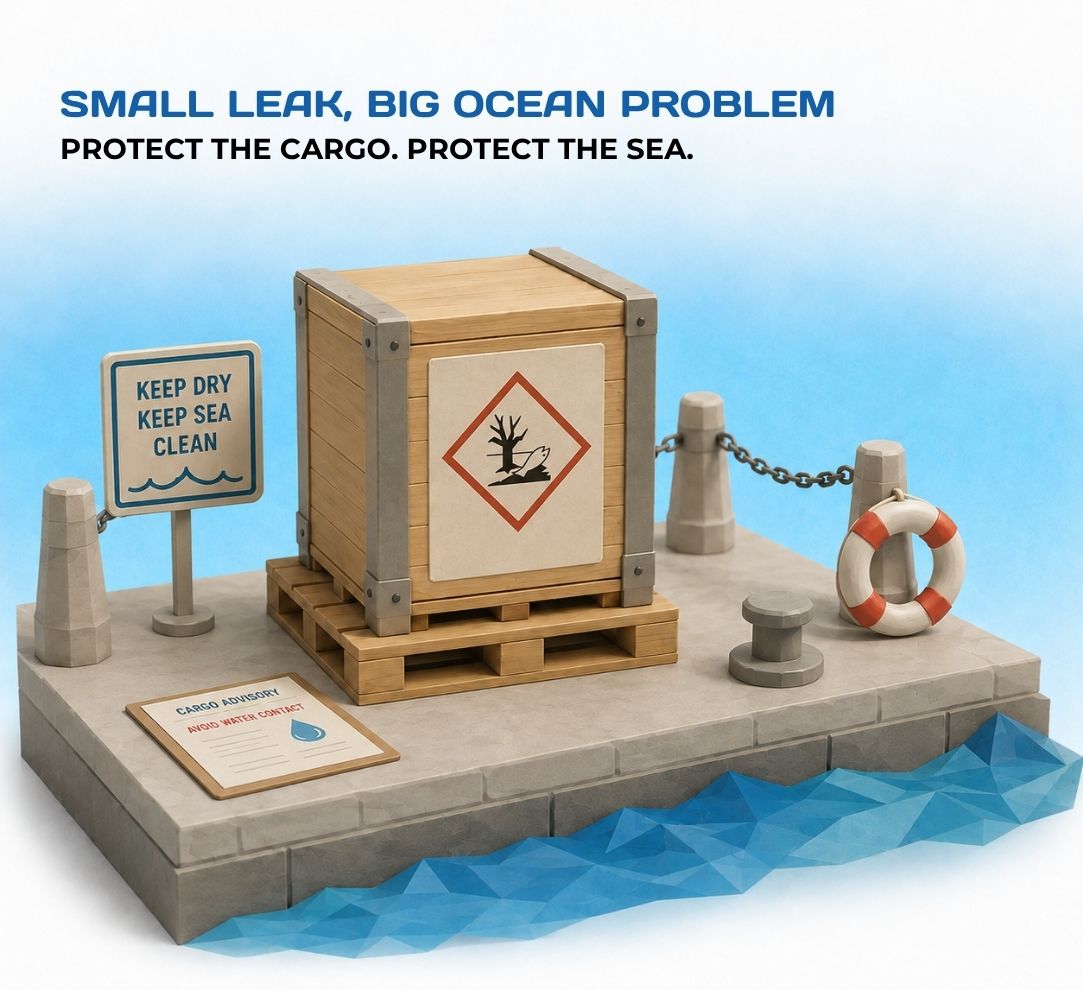
Marine pollutants and environmentally hazardous substances may require the environmental hazard mark — the symbol with the dead tree and fish.
It looks simple.
But it carries an important message:
This cargo may harm the environment if released.
That symbol is not decoration.
It tells carriers, ports, handlers, customs, and logistics teams that the shipment needs proper attention.
Because the goal is not just to move the cargo.
The goal is to make sure the cargo stays safely contained throughout the journey.
What businesses often get wrong
Many businesses assume that if a product is not flammable, explosive, or corrosive, it is normal cargo.
That assumption can be dangerous.
A shipment may still require Dangerous Goods handling if it poses environmental risk.
Common mistakes include:
- Not checking the SDS / MSDS properly
- Missing the marine pollutant classification
- Using the wrong UN number
- Not applying the environmental hazard mark
- Using unsuitable packaging
- Not preparing the correct declaration
- Treating the cargo as normal general cargo
- Assuming the supplier’s packaging is automatically enough
- Checking the requirements only after the cargo is already moving
And the worst time to discover this?
When the shipment is already at port.
That is when “small paperwork issue” can become “very expensive delay.”
Why this matters for Malaysia and regional shipping
Malaysia and Southeast Asia handle a lot of chemical, industrial, agricultural, manufacturing, cleaning, beauty, oil and gas, and marine-related cargo.
Many of these products may look ordinary to the sales team.
A drum.
A carton.
A bottle.
A pail.
A sack.
A pallet.
But to the logistics team, the cargo may require environmental hazard handling, proper documentation, and suitable packaging.
Especially when the shipment involves sea freight, port handling, cross-border movement, or storage near water-sensitive areas.
The product may not look dramatic.
But if it leaks, it can create real consequences.
And the ocean does not accept:
“Oops, we didn’t know.”
The solution: check the environmental risk before shipping
Marine pollutant shipments can usually move properly when the right steps are taken early.
The key is to check before the cargo moves.
Before shipping, businesses should ask:
- Does the product have environmental hazard classification?
- Does the SDS / MSDS mention aquatic toxicity or marine pollutant risk?
- Is the cargo classified under UN 3077, UN 3082, or another UN number?
- Does it require the environmental hazard mark?
- Is the packaging suitable to prevent leaks?
- Are the documents and declarations correct?
- Is the carrier able to accept this cargo?
- Are handlers aware of the cargo requirements?
- Has the transport mode been checked properly?
This is not about making shipping complicated.
It is about preventing the wrong kind of surprise.
Because “it looks normal” is not a compliance strategy.
Final thought
Marine pollutants are a good reminder that Dangerous Goods are not always dangerous-looking.
Some cargo is dangerous because it burns.
Some because it explodes.
Some because it reacts.
And some because it quietly harms the environment when it leaks.
So when we say Cargo That Shouldn’t Touch Water, we don’t mean the cargo is afraid of water.
We mean the water should not be exposed to the cargo.
That is the real risk.
And that is why marine pollutants need to be classified, packed, labelled, documented, and handled properly from the start.
Because in logistics, prevention is always cheaper than clean-up.
FAQ
What is a marine pollutant?
A marine pollutant is a substance that may harm the marine environment if it leaks or spills during transport.
Are marine pollutants considered Dangerous Goods?
Some marine pollutants are classified as Dangerous Goods, often under Class 9 as environmentally hazardous substances.
What are UN 3077 and UN 3082?
UN 3077 refers to environmentally hazardous substances in solid form.
UN 3082 refers to environmentally hazardous substances in liquid form.
Does “Cargo That Shouldn’t Touch Water” mean water will damage the cargo?
No. In this article, it means the cargo should not leak into water because it may harm the marine environment.
What should businesses check before shipping marine pollutants?
Businesses should check the SDS / MSDS, UN classification, environmental hazard marking, packaging suitability, documentation, carrier acceptance, and transport mode requirements.
Not sure if your cargo is a marine pollutant?
Speak to Alien Logistics before you ship.
We’ll help you check whether your cargo falls under marine pollutant or environmentally hazardous substance requirements, review the documentation, packaging, labelling, and shipment arrangement properly — so your cargo moves without unnecessary environmental drama.
Because honestly, it is much easier to classify it correctly before shipping…
Than explain a leaking drum after.
Come, talktome@alienlogistics.com — we’re always ready to help.