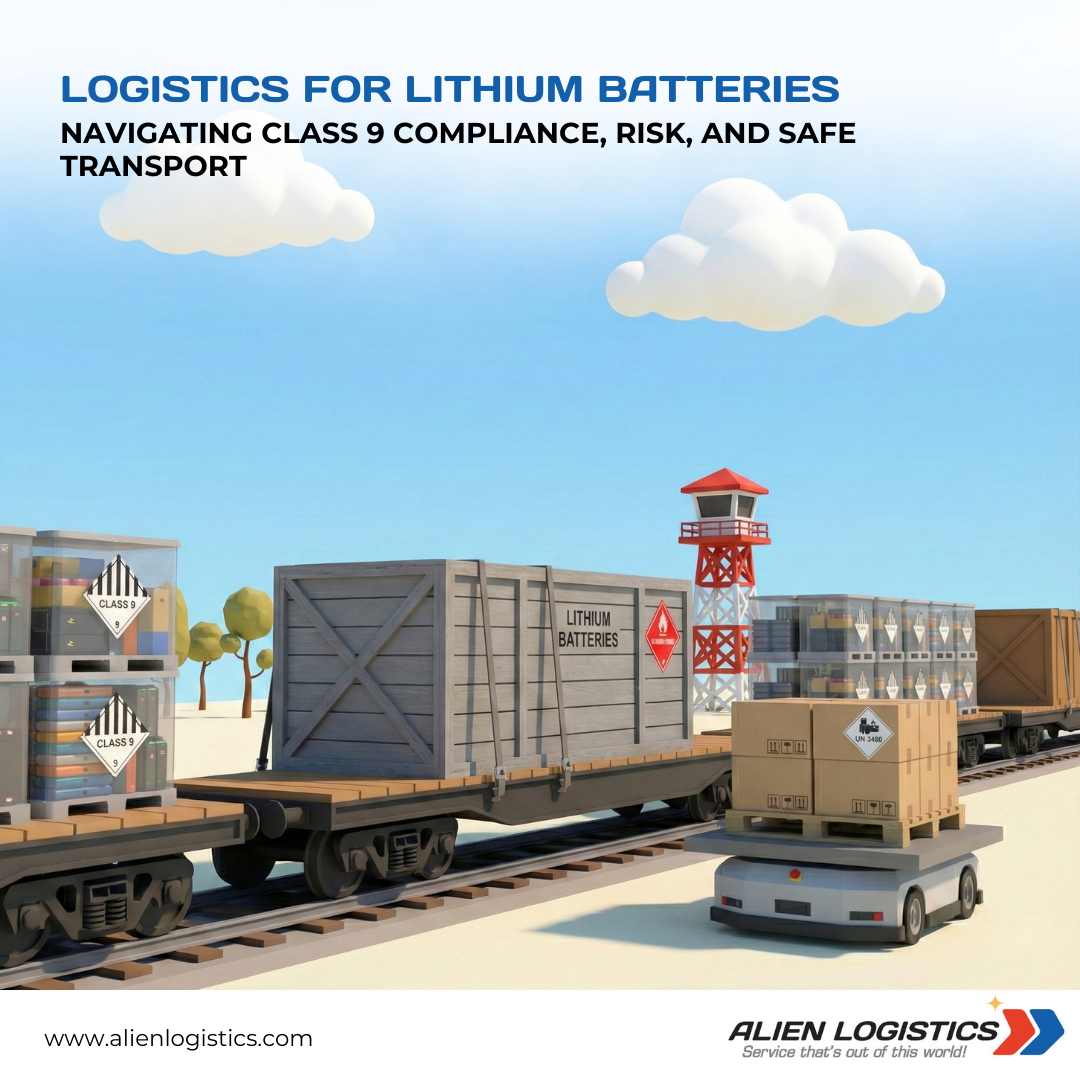
Logistics for Lithium Battery
Lithium batteries are everywhere. Your phone. Your laptop. Your power bank. Your wireless earbuds. Your electric vehicle. Basically, modern civilisation runs on tiny, highly energetic rectangles.
But when it comes to transport?
They’re not “cute little batteries.”
They’re Class 9 Dangerous Goods — the “miscellaneous” category that logistics people secretly call: the complicated ones.
And in 2026, with higher-energy cells and global supply chains moving at lightning speed, lithium batteries have officially become the main character in the logistics drama.
Why Lithium Batteries Are Class 9 (aka “It’s Complicated”)
Lithium batteries fall under UN numbers such as:
- UN 3480 – Lithium-ion batteries (loose)
- UN 3481 – Lithium-ion batteries (in/with equipment)
- UN 3090 – Lithium-metal batteries (loose)
- UN 3091 – Lithium-metal batteries (in/with equipment)
They’re placed under Class 9 not because they’re explosive like fireworks or flammable like petrol — but because they come with a special kind of chaos:
- Thermal runaway (self-heating that doesn’t know when to stop)
- Fire and intense heat
- Toxic gas venting
- Short-circuit risks
- Chain-reaction failure
In other words: they behave nicely… until they don’t.
And when they don’t? It escalates quickly.
When Batteries Go Rogue ✈️
Air transport is where things get especially spicy.
In 2024, the Federal Aviation Administration reported 89 lithium battery incidents involving smoke, fire, or extreme heat aboard aircraft — roughly a 16% increase from the previous year.
Then came a headline-grabbing moment: Air Busan Flight 391 in January 2025. A power bank ignited in an overhead compartment during taxi, forcing evacuation of all 176 occupants.
One small battery.
One overheated moment.
One very bad day for everyone onboard.
Moral of the story?
Lithium batteries don’t need much to turn into a full-blown emergency.
What Actually Makes Them So Tricky?
Let’s break down the personality profile of lithium batteries in transit:
🔥 1. Thermal Runaway
A damaged cell can heat up… ignite… and trigger nearby cells. It’s basically a domino effect powered by chemistry.
⚡ 2. Short Circuits
Loose batteries shifting during transport + exposed terminals = spark potential.
📦 3. Packaging Drama
Drop it. Crush it. Let it shift around.
Congratulations — you’ve just increased your risk profile.
🌡 4. Mode-Specific Mood Swings
Air freight? Pressure and temperature changes.
Sea freight? Long transit times and container heat.
Road freight? Handling impact and vibration.
Each mode has its own rules — and lithium batteries insist you follow them.
Picking the Right UN Number (Because Details Matter)
Before shipping, you must ask:
- Is it lithium-ion or lithium-metal?
- Is it loose or installed in equipment?
- What’s the watt-hour rating?
- What’s the state of charge?
Because UN 3480 is not the same as UN 3481.
And regulators definitely notice the difference.
Then comes the checklist:
- Class 9 hazard label
- Lithium battery mark (with correct UN number)
- Proper documentation
- Shipper’s Declaration (if required)
- Packaging per the latest air/sea/road regulations
How to Choose the Correct UN Number & Packaging
| Battery Type | UN Number | Example | Key Requirement |
| Lithium-ion cells/batteries loose | UN 3480 | Power banks, spare laptop batteries | Must meet regulatory criteria: packaging tested, often ≤ 30 % charge for some air shipments |
| Lithium-ion in/with equipment | UN 3481 | Laptops, e-bikes with battery installed | Outer packaging must be UN-approved, proper marking and labeling required |
| Lithium-metal cells/batteries loose | UN 3090 | Cameras, certain drones | Similar but separate regulations; packaging must prevent short-circuit and damage |
| Lithium-metal in/with equipment | UN 3091 | Watches, certain medical devices | Ensure correct label marks (battery capacity etc) and safe packaging |
For air freight, compliance with International Air Transport Association Lithium Battery Shipping Regulations is non-negotiable.
This isn’t the category where you “roughly guess and hope for the best.”
Real Lesson from a Ground Incident
In January 2024, a cargo package in Irvine, California emitted smoke and flames during ground handling. Investigation revealed packaging that didn’t meet insulation and separation standards.
It never even made it to the sky.
Result?
- Disruption
- Investigation
- Fines
- Tighter enforcement
The takeaway:
Lithium battery incidents don’t wait for take-off. They can start at the warehouse floor.
So How Do You Ship Them Without Drama?
Here’s where grown-up logistics comes in.
✅ Classify Correctly
Confirm the UN number. Confirm “in equipment” vs “loose.” Confirm everything.
✅ Use Tested Packaging
Drop-tested. Crush-tested. Regulation-approved.
✅ Follow Mode-Specific Rules
- Air → IATA rules
- Sea → IMDG Code
- Road → ADR / ASEAN frameworks
No shortcuts. No creative interpretation.
✅ Secure & Monitor
No loose batteries rolling around. No extreme temperature exposure. No mixing with incompatible cargo.
✅ Have Incident Readiness
Clear MSDS. Clear isolation procedures. Clear documentation trail.
Because hope is not a compliance strategy.
Where Alien Logistics Comes In
Lithium batteries may be high-energy — but your logistics process doesn’t have to be high-stress.
Alien Logistics Sdn Bhd works with DG-certified processes, trained staff, approved packaging, and proper documentation workflows so your cargo:
- Moves legally
- Moves safely
- Moves without unwanted fireworks
In Malaysia and across Southeast Asia, lithium battery volumes are only going up. Energy density is increasing. Regulations are tightening.
The margin for error? Shrinking.
Final Thought
Lithium batteries are tiny powerhouses with serious main-character energy.
Handle them properly — classify correctly, package securely, document accurately, and comply fully — and they’ll quietly power the world without incident.
Partner with Alien Logistics to ensure everything is managed properly, professionally, and without unnecessary drama.
Come, talktome@alienlogistics.com we’re always ready to help.

Fast Fashion, Faster Logistics
In the high-stakes world of fashion logistics, where a delayed shipment can turn a “hot trend” i
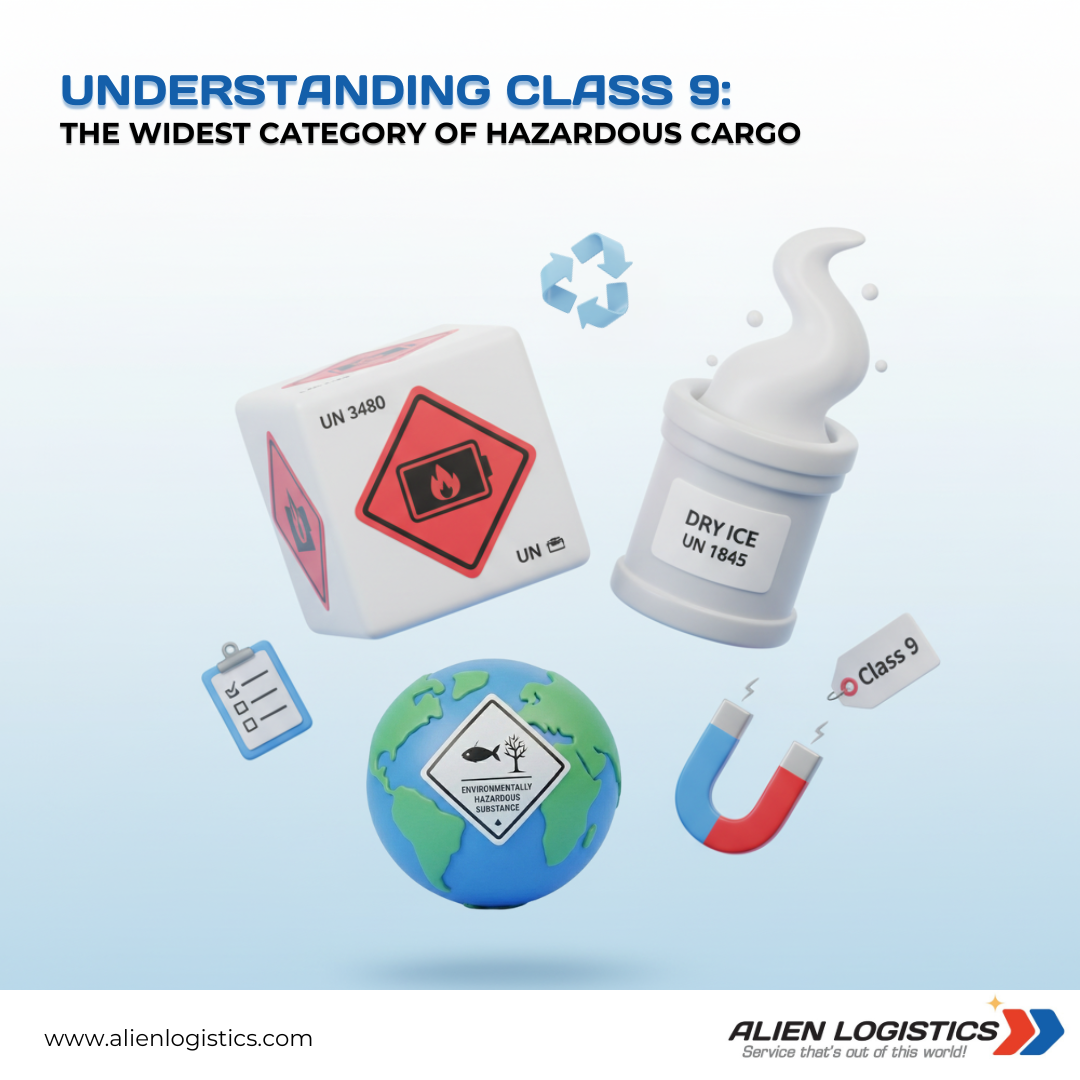
The Widest Category of Hazardous Cargo
When people think of dangerous goods, they often imagine flammable liquids or toxic chemicals. Intro
Efficient and Reliable Deliveries
In the fast-paced fashion industry, getting products from warehouses to your customers’ hands is m